Thursday, February 27, 2014
Britain At War Magazine 03/2014
THE WAR in Europe was over and the men who had been prisoners of the enemy were flown back home. With more than 350,000 individuals to transport and process, it was a major logistical operation which, to their credit, those in authority generally carried out with considerable efficiency. The returning men had fought for their country and, in many cases, been held captive for years. Their homecoming, one would have imagined, would have been amongst the most celebrated of the Second World War. At the same time, what tales these men must have had to tell. Fighting, surrender, capture; the trials of internment, their treatment at the hands of the Germans; surely their stories would fill many a volume? Yet when we researched Operation Exodus, as the return of the prisoners was code-named, we found little had been written on the subject, particularly in respect of facts and figures, other than the occasional first-hand account. I suppose people had already moved on. They had other things to think of. Life was going to be very different with the end of the fighting, and not necessarily for the better. Indeed, for some it was a difficult homecoming. Houses had been destroyed, loved ones dead or disappeared.
Monday, February 24, 2014
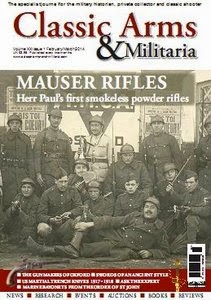
Classic Arms & Militaria 02-03/2014
The widespread adoption of firearms which used metallic cased cartridges from about 1870 onwards created a requirement for inert cartridges to teach the soldier how to manipulate his weapon. This became increasingly important with die advent of magazine rifles. The only way that an instructor could be sure that his pupils had assimilated the lesson was to see them conduct a successful loading and firing cycle with inert ammunition. During the muzzle-loading era, the lack of dummy ammunition was not an issue. Loading drill could be conducted without it and lightly charged blank or "blunt" cartridges could be used when necessary to give the soldier a better impression of his firearm's function. As firearms grew more technically complex, armourers and other artificers needed inert ammunition to check functionality and wear. Consequently, a new type of inert ammunition the Drill or Dummy cartridge began to appear. In 1871 die famous Scottish gunmaker Alexander Henry advocated a dummy cartridge for use in the .577 Snider rifle. The main part of the case and the tapered "bullet" were made from turned boxwood. The head was brass and the "primer" was an India-rubber plug designed to absorb die impact of the striker. Mr Henry patented his design (No. 3257/1870) and promoted it vigorously amongst die Volunteer Movement. He claimed that soldiers could "..make constant HOME PRACTICE without danger, expense or injury to the rifle and the manipulation is a perfect as though using live cartridges". Henry's dummy cartridges cost 2 shillings and 6 pence for 10 or 100 might be had for a guinea including rail delivery. Specimens are rare today.
Classic Arms & Militaria 01/2014
Early firearms were invariably smooth-bore weapons because, initially, no one understood that putting grooves in the barrel of a gun to make the ball spin would increase its accuracy Even after this discovery was made, a rifled barrel was not very easy to make by hand and it was not until the beginning of the 16th century that rifled weapons began to appear regularly in Europe. These first rifles were of either Austrian or German manufacture and although they were accurate and popular with the sporting shooter, they never gained general acceptance by the military. The problem was loading. If the designer increased the size of the ball so that it was a tight fit in the bore, forcing the ball down the barrel past the rifling made it difficult to load and, if the ball was looser, the accuracy of the weapon was reduced to barely that of an equivalent musket. Very-early rifle shooters used a wooden mallet to knock the ball down the rifling, but this was not totally-satisfactory and rifles did not become really popular until their loading problems were partially overcome by the development of a process called 'patch-loading'. This involved the use of a patch of paper, cloth or even leather which was wrapped around the ball before it was inserted into the barrel and forced down to seat on to the charge. The patch gripped the grooves in the barrel sufficiently to impart the required spin to the ball and so rendered the rifling effective.
Aero Modeller March/April 2014
One of the special appeals of competition free-flight is that it's a purely objective sport, with simply a stopwatch to decide the result, rather than the subjective opinion of some judge. It's also a man (or woman) versus the elements. You, the flyer, will have pre-adjustcd several factors on the model that determine the flight (CG position, tailplane incidence for power or tow and for glide, rudder setting, differential wing incidence, propeller variable pitch changes,) and several of these maybe timer-controlled in flight. But in the end it is you who decides when to launch and that is when the elements bit comes into play. That model is going to end up somewhere downwind and you're going to need it back for several more rounds. Deciding when to launch usually means judging the air (temperature, wind speed and direction,) with the aim of finding a thermal to boost the flight performance to provide a max. When the model DTs (you did start the timer or set the fuse...?) is when the first stage of the retrieval phase begins. However, there's a lot you can do long before you get to the flying field that will help you to go home with the same number of models you set out with.
Subscribe to:
Posts (Atom)