Monday, February 24, 2014
Aviation News 03/2014
With the successful conclusion of Operation Corporate, the campaign to retake the Falkland Islands from Argentina in 1982, the RAF found itself faced with supporting a large UK military presence 8,500 miles (13,680km) from home. It had no strategic transport aircraft and its air-to-air refuelling (AAR) tanker fleet was, inevitably, going to be overstretched. An ongoing programme of Vickers VC10 tanker conversions would help, but much of the life of its existing Handley Page Victor tankers had been consumed during Corporate. The RAF therefore had an urgent requirement for a large tanker/transport and British Airways (BA) was identified as having a suitable aircraft available. Six long-range Lockheed L-1011 TriStar 500 trijets had been ordered in August 1976, with the first placed in service during January 1979 and the last in May 1981. The new aircraft performed admirably on the carrier's long, thin routes (long haul, with passenger volumes insufficient for cost-effective service with larger aircraft), but proved somewhat costly to operate. Struggling to raise cash during a period of recession, BA took the opportunity to sell its nearly-new TriStar 500 fleet to the RAF. A deal was struck later in 1982 and a period of transition followed. The first to be transferred, G-BFCF was withdrawn from commercial service in December and by the following March all six had ceased scheduled flying. However three made temporary returns to BA service.
Airforces Monthly 03/2014
DURING A visit to the Dassault Rafale combat aircraft final assembly line at Bordeaux-Mérignac on January 10 Jean-Yves le Drian, France's Minister for Defence, awarded a contract to Dassault for development of the F3R standard Rafale from France's defence procurement agency, the Direction Générale de l'Armement (DGA- General Directorate for Armament). The F3R is a further evolution of the Rafale F3 standard and will enable Dassault to integrate the European Meteor long-range air-to-air missile produced by MBDA, the Thaies PDL-NG new-generation laser designator pod and HAMMER (Highly Agile Modular Munition Extended Range), the laser homing version of the Sagem AASM (Armement Air-Sol Modulaire or Modular Air-to-Ground Weapon) that was partially integrated as an urgent operational requirement for France's Operation Serval in Mali. The DGA plans to buy 20 PDL-NG pods, of which 16 will be delivered between 2018 and 2019. The F3R will also include upgrades to Rafale's sensors and systems. Validation of the F3R standard is scheduled for 2018.
Aeroplane Magazine 04/2014
Following a two-year restoration in Cosford's Michael Beetham Conservation Centre, Britain's only surviving Hawker Siddeley Kestrel was unveiled in the Research and Development Hangar at the RAF Museum Cosford on January 24, just short of 50 years after the first flight of the type. The historic machine, XS695, is the only Kestrel ever to go on display in the country of its birth. Not only is XS695 an important addition to the RAF Museum collection, but it now provides Britain with the only major "link" in the Hawker Harrier V/STOL story not previously represented in the UK-wide museum system, completing the story of what is arguably the most innovative combat aircraft ever developed in Britain, three years after the last Harriers were retired from RAF service. Britain's last remaining Kestrel was the eighth of nine Kestrel FGA.l development aircraft, making its first flight from Dunsfold on February 19, 1965, with Hawker test-pilot Duncan Simpson at the controls. After almost 6hr of test flights, on March 30, 1965, XS695 was delivered to the Tripartite (Anglo-American-German) Kestrel Evaluation Sqn, at West Raynham. The unit had been set up to evaluate vertical take-off aircraft in simulated sen-ice conditions.
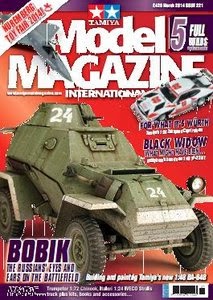
Tamiya Model Magazine International 03/2014
In 1960, Boeing bought Vertol Aircraft Co., a helicopter manufacturer in Philadelphia, Pa. The company had three tandem-rotor helicopters in production: the Chinook for the Army, the Sea Knight for the Navy and the Marines and the commercial 107-11 for the airlines. Chinooks first were used in combat in 1965 during the Vietnam conflict. By 1968, the Chinook had put in 161,000 hours of flying time, carrying 22.4 million passengers and more than 1.3 million tons of cargo. During the last days of the war, one Chinook is reported to have carried 147 refugees in a single lift. CH-47A, B and C models served with distinction for a decade until the war's end in 1975. During 2002, Boeing was developing the CH-47F, scheduled for first production in 2004 and was under contract to modernize at least 300 Chinooks to the new F-model standard, which featured reduced vibration, an integrated cockpit control system and more powerful engines with digital fuel controls. These improvements would make the Chinook fully compatible with 21st century operational and war-fighting requirements and improve the aircraft's efficiency and effectiveness. (From Boeing's website). The CH-47 as represented in the Trumpeter box is a machine assigned to the US Army Aviation Test Board at Fort Rucker, Alabama. This helicopter was used for logistics evaluations.
Subscribe to:
Posts (Atom)


