THE USAF AWARDED Sikorsky Aircraft a SI.28-billion engineering and manufacturing development (EMD) contract to develop a new Combat Rescue Helicopter (CRH) on June 26. Based on the US Army's UH-60M Black Hawk, the type will replace the USAF's current fleet of HH-60G Pave Hawks. Although the effort includes the delivery of four EMD airframes and seven aircrew and maintainer training systems, the USAF plans to purchase up to 112 new Combat Rescue Helicopters at a cost of $7.9 billion. Compared to the HH-60G, the CRH will feature increased fuel capacity and more cabin space. While Sikorsky will build the helicopters, Lockheed Martin is the major sub-systems supplier and will install the mission planning system, defensive systems, data links, mission computers and adverse weather sensors, and carry out integration of all mission-unique sub-systems. The first two helicopters will be delivered to the USAF in 2018 and a second pair will follow in 2019.
Saturday, August 9, 2014
FlyPast 09/2014
With its distinctive red, white, blue and orange roundels, the Royal Netherlands Air Force Historic Aircraft Foundation s Spitfire IX MK732 has been a well-known participant on the European airshow circuit for over two decades. The Dutch colour scheme reflects MK732 s second military career; its first was with the RAF, with which it notched up a very distinguished combat record, including operations on D-Day itself. Built at Castle Bromwich in the UKs Midlands in early 1944, MK732 was issued to 485 Squadron RNZAF in April, based at Selsey, an advanced landing ground in Sussex. Initially it was painted with the codes 'OU-Q', but when the moment came to apply the black and white 'invasion stripes' on the eve of D-Day, its individual letter was changed to U'for-Uncle. The Operations Record Book for 485 Squadron lists several pilots, including Fg Off M C Mayston, Fit Lt K J Macdonald, Pit Off H W B Patterson and Wg Cdr P J Simpson, that flew MK732 on beach patrols between June 6 and 8, 1944. During D-Day the 'Kiwi' unit had 24 pilots on strength, sharing 18 Spitfires. More often than not, Patterson would fly MK732, and it was named Baby Bea K after his fiancee, Beatrice.
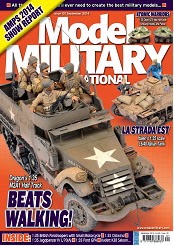
Model Military International 09/2014
World War I, the "Great War", was the first mechanized war in history. The development of smokeless gunpowder and the fully-automatic machine gun in the late 19th century had changed the conditions for infantry combat, but the invention of the internal combustion engine, the automobile and truck, and the caterpillar tracked tractor would change forever the very nature of modern ground warfare. At the beginning of the war in 1914, horses and mules far outnumbered motor vehicles, and many armies had only started to investigate the use of cars and trucks to assist in, and then take over, the task of transporting troops and supplying them in the field. The development of useful motor vehicles was aided by the needs of the various military forces, and by the beginning of World War I, there were available several hundred makes of cars and trucks, several of the latter being four-wheel-drive models with useful cross-country capabilities. Tests conducted by the US Army before the war had proven that automobiles and trucks were capable of hauling troops and supplies much farther and faster than horses and mules could.
Airfix Model World 09/2014
I've had some interesting correspondence since my last editorial, which highlighted the strengthening strips on the upper wings of the Spitfire. The subject was ripe for discussion due to Steve Budd's build of Airfix's new Spitfire Mk.Vb in the same issue, especially because Steve removed the strips on his rendition. One particular reader exclaimed that Steve had "ruined" the model by omitting the strips. Overly harsh I felt, especially as the aircraft in question modelled by Steve, 'Buck' McNair's AB264/GN-H, couldn't have had the strips fitted at the time of the scheme depicted, because Airfix's decals are for March 1942. This mod, it seems, was indeed a wartime addition but wasn't fitted until July 1942 and, as it was deemed 'Class 4 and on repair', this precluded user units from carrying it out in the field...it would have been done on the production line or during lengthy repairs. Regardless, the subject will undoubtedly confound modellers due to the huge lack of photos of Spitfires actually fitted with the strips. Tamiya's old 1/48 Spitfire Mk.Vb has the strips moulded on its wings, but the instructions in my boxing demand that they be removed. Ultimately, a period photo of the aircraft to be modelled is the Holy Grail.
Subscribe to:
Posts (Atom)