In 1961 the Swiss Air Force decided on a serious upgrade of their aerial defence capabilities and ordered the Marcel Dassault Mirage III. With the Doppler terrain following radar, Mach 2 capability and the IBIS fire control system the Mirage was cutting edge technology in 1961. 100 of these supersonic fighters were ordered in 1961 but they had to be customised to fit special Swiss requirements. These alterations were structural and so extensive that the Swiss Air Force received a very different version, which was known as the MIRAGE III S. The changes included a complete new radar and fire control system, the HUGHES TARAN 18, which could fire the AIM 26B Falcon and the SIDEWINDER missiles instead of the French MATRA 530. Further alterations included an extendable nose gear, strengthening of the airframe, leading edges, landing gear and the adaption of JATO bottles. The original Doppler radar had only limited use in a mountainous region and takeoffs and landings in this environment put a special strain on the airframes and landing gear. The aircraft also were stored in mountain caverns and the extended nose gear helped in lowering the tail fin in order to pass the low entrances of these caverns. Once in service however, the Swiss Mirages performed outstandingly, were loved by the pilots and remained in Service until 1988. In 1980 all aircraft underwent an extensive midlife update, which featured the addition of canard wings and the adoption of a two tone Low-Viz grey paint scheme as the most recognisable features. Beside the MIRAGE III S the Swiss Air Force also operated the Recon version III R with the camera nose and the III B trainer version, in total 61 machines, of which only three were lost due to accidents.
Saturday, August 9, 2014
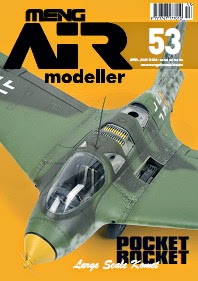
AIR Modeller Issue 53
We begin with the cockpit and there is an immediate choice of parts between the fully plastic moulded instrument panel or the version with photoetched panel sections. I am normally a bit sceptical about the photoetched versions as they can lack the required depth but when I glued the etched parts onto the plastic backing part the finished effect with the fine panel gaps persuaded me to go with this version. The cockpit tub is well handled but the restrictions of the moulding process mean that there is no horizontal strap detail on the fuel cells, only the vertical straps. The kit provides a nice set of photoetched seat harnesses which were soft enough to just bend into a natural sagged position in the seat tub. Once shaped these were painted with Vallejo acrylics and Mr Metal Color Chrome Silver for the buckles. It is well worth keeping the pilot's seat separate from the bulkhead until you have the seat belts painted and fitted. The various parts of the cockpit all locate together precisely to form a very solid tub. I replaced the moulded oxygen hose with a flexible resin tube from the MDC range for a more natural look. With the cockpit bulkhead and floor tub joined I also added the pair of fuie lines that run between the bulkhead and the fuel cells using lead wire to make these.
Military Machines International 09/2014
Welcome to this month's issue of Military Machines International, and after my personal disappointment of not being able to attend the D-Day commemorations in Normandy last month due to my workload and the timing of the production schedule (as mentioned in last month's editorial), I have at least been able to get out and about to some of my favourite shows around the UK now that the show season is underway, and so far at least the weather has been very kind to us. At the time of writing it is mid-July, and despite the fact that you will be reading this issue of the magazine in August, I have yet to attend some of the major shows in the UK such as the War & Peace Revival, but judging by the way 2014 is shaping up so far, there could well be some interesting vehicles waiting in the wings along with a few surprises. In other news, the eagle-eyed amongst you may well have spotted a new face on this page, and I would like to take this opportunity to welcome a new contributor onboard the Editorial team, namely John Blackman, who is already a familiar face to many thanks to his work within the world of military vehicles and publishing. John will be taking on the role of Contributing Editor at MMI, bringing with him a wealth of experience and some exciting new features for inclusion in the magazine, all of which will no doubt enable the magazine to go from strength to strength. Anyway, that's enough from me, and we'll be back next month with more features and another round of show reports from the 2014 season, but for now I'll leave you now to enjoy this month's feature-packed issue - Ed.
Classic Military Vehicle 08/2014
You could be forgiven for thinking that, beyond the obvious military connection, the M561 Gama Goat, Steyr-Puch Pinzgauer, and Volvo Laplander have little in common. But, amongst others, all three were considered for the role eventually allocated to the Land Rover 1-tonne forward control... Land Rover's first 100% purpose-designed military vehicle production until the Wolf appeared in the early nineties. Work on this project had started back in the sixties when the Ministry of Defence (MoD) identified what it described as a 'serious gap in the future vehicle range between the Land Rover, with a capacity of 0.5 to 0.75 ton, and the 4-ton Bedford MK/ MJ trucks.' Most pressing was a specific and immediate need for a heli-portable artillery tractor and ammunition limber for the new L118 105mm light gun, which was too heavy to be towed by existing Land Rovers. It was also believed that a vehicle that could satisfy this particular role would also be suitable for a range of other needs for which 'existing smaller vehicles were inadequate [but for which] larger ones were either too expensive or tactically unacceptable.'
Subscribe to:
Posts (Atom)