Saturday, August 9, 2014

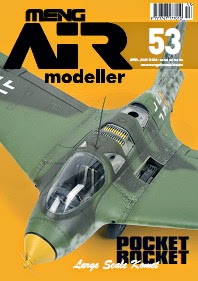
AIR Modeller Issue 53

We begin with the cockpit and there is an immediate choice of parts between the fully plastic moulded instrument panel or the version with photoetched panel sections. I am normally a bit sceptical about the photoetched versions as they can lack the required depth but when I glued the etched parts onto the plastic backing part the finished effect with the fine panel gaps persuaded me to go with this version. The cockpit tub is well handled but the restrictions of the moulding process mean that there is no horizontal strap detail on the fuel cells, only the vertical straps. The kit provides a nice set of photoetched seat harnesses which were soft enough to just bend into a natural sagged position in the seat tub. Once shaped these were painted with Vallejo acrylics and Mr Metal Color Chrome Silver for the buckles. It is well worth keeping the pilot's seat separate from the bulkhead until you have the seat belts painted and fitted. The various parts of the cockpit all locate together precisely to form a very solid tub. I replaced the moulded oxygen hose with a flexible resin tube from the MDC range for a more natural look. With the cockpit bulkhead and floor tub joined I also added the pair of fuie lines that run between the bulkhead and the fuel cells using lead wire to make these.

Military Machines International 09/2014

Welcome to this month's issue of Military Machines International, and after my personal disappointment of not being able to attend the D-Day commemorations in Normandy last month due to my workload and the timing of the production schedule (as mentioned in last month's editorial), I have at least been able to get out and about to some of my favourite shows around the UK now that the show season is underway, and so far at least the weather has been very kind to us. At the time of writing it is mid-July, and despite the fact that you will be reading this issue of the magazine in August, I have yet to attend some of the major shows in the UK such as the War & Peace Revival, but judging by the way 2014 is shaping up so far, there could well be some interesting vehicles waiting in the wings along with a few surprises. In other news, the eagle-eyed amongst you may well have spotted a new face on this page, and I would like to take this opportunity to welcome a new contributor onboard the Editorial team, namely John Blackman, who is already a familiar face to many thanks to his work within the world of military vehicles and publishing. John will be taking on the role of Contributing Editor at MMI, bringing with him a wealth of experience and some exciting new features for inclusion in the magazine, all of which will no doubt enable the magazine to go from strength to strength. Anyway, that's enough from me, and we'll be back next month with more features and another round of show reports from the 2014 season, but for now I'll leave you now to enjoy this month's feature-packed issue - Ed.
Classic Military Vehicle 08/2014

You could be forgiven for thinking that, beyond the obvious military connection, the M561 Gama Goat, Steyr-Puch Pinzgauer, and Volvo Laplander have little in common. But, amongst others, all three were considered for the role eventually allocated to the Land Rover 1-tonne forward control... Land Rover's first 100% purpose-designed military vehicle production until the Wolf appeared in the early nineties. Work on this project had started back in the sixties when the Ministry of Defence (MoD) identified what it described as a 'serious gap in the future vehicle range between the Land Rover, with a capacity of 0.5 to 0.75 ton, and the 4-ton Bedford MK/ MJ trucks.' Most pressing was a specific and immediate need for a heli-portable artillery tractor and ammunition limber for the new L118 105mm light gun, which was too heavy to be towed by existing Land Rovers. It was also believed that a vehicle that could satisfy this particular role would also be suitable for a range of other needs for which 'existing smaller vehicles were inadequate [but for which] larger ones were either too expensive or tactically unacceptable.'

Combat Aircraft Monthly 09/2014

THE USAF AWARDED Sikorsky Aircraft a SI.28-billion engineering and manufacturing development (EMD) contract to develop a new Combat Rescue Helicopter (CRH) on June 26. Based on the US Army's UH-60M Black Hawk, the type will replace the USAF's current fleet of HH-60G Pave Hawks. Although the effort includes the delivery of four EMD airframes and seven aircrew and maintainer training systems, the USAF plans to purchase up to 112 new Combat Rescue Helicopters at a cost of $7.9 billion. Compared to the HH-60G, the CRH will feature increased fuel capacity and more cabin space. While Sikorsky will build the helicopters, Lockheed Martin is the major sub-systems supplier and will install the mission planning system, defensive systems, data links, mission computers and adverse weather sensors, and carry out integration of all mission-unique sub-systems. The first two helicopters will be delivered to the USAF in 2018 and a second pair will follow in 2019.