Thursday, October 24, 2013

Jets 01-02/2013

After a busy few months travelling and moving house, I've enjoyed a fairly relaxing time over the last few weeks, settling into my new office/study and getting acquainted with the village. We are now situated under the flightpath for East Midlands and during the evenings all manner of transport aircraft ply their trade in and out of Castle Donington. The droning turboprops and rumbling jets make a pleasant (to me, at least!) comparison to the whisper-quiet airliners that frequent the airport during the daytime hours. Their dwindling numbers has prompted me to get out and about to try and see as many of these types before they disappear from our skies completely. They may be noisy and inefficient, but they still hold a sense of historical importance and I feel it important to capture them on film before it's too late. I guess this sense of nostalgia has also been triggered by researching the article on the Jet Preservation Pioneers (page 18) and trawling through my photograph collection to help illustrate it. Although I am too young to remember Ormond Haydon Baillee (OHB) and Spencer Flack's Hunter (although I did see him race his Beech Baron to dramatic effect), I distinctly remember being invited to Cranfield as a 13-year-old to enjoy a day with Sandy Topen s Vintage Aircraft Team. I got to crawl all over the Vampires and Venoms and while the photographs are too poor to illustrate this magazine, they brought back many happy memories.

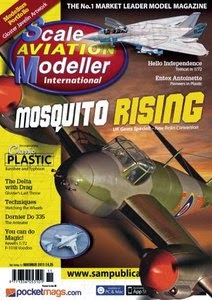
Scale Aviation Modeller International 11/2013

This is a very welcome re-release of Revell's Voodoo, previously issued with USAF or Canadian options. This version features two Air National Guard aircraft. The kit comes in an end-opening box containing three large light grey sprues, one transparent sprue, a packed, colourful decal sheet and a six-page instruction booklet. All the mouldings look crisp and well detailed, with fine recessed panel lines. The McDonnell F-101 Voodoo was originally designed by as a long-range bomber escort SAC, but was instead developed as a nuclear-armed fighter-bomber for the Tactical Air Command and as a photo-reconnaissance aircraft based on the same airframe. Extensively modified versions were produced as an all-weather interceptor aircraft, serving with the Air Defense Command, the Air National Guard, and the Royal Canadian Air Force. The RF-101 reconnaissance variant was instrumental during the Cuban Missile Crisis and saw extensive service during the Vietnam War. Interceptor versions served with the Air National Guard until 1982, and in Canadian service they were a front line part of NORAD until their replacement with the CF-18 Hornet in the 1980s.

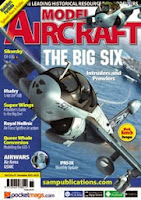
Model Aircraft 11/2013

From 1945 until September 1949 the postwar Royal Hellenic Air Force was engaged in a bloody conflict that erupted between Greek communists and the Hellenic Armed Forces after the German retreat from Greece. During this period the Spitfires and their pilots battled on constantly... While World War II was about to end in most parts of Europe, bringing peace and prosperity, this was not the case with Greece, which was about to enter a new phase of fraternal bloodshed. Since October 1944 the German occupation forces had been retreating from western Greece to act as reinforcements against the Allied invasions in Normandy and Italy. After the last German soldier left from Athens, fleeing northbound, during November 1944 a political vacuum opened up. The Greek government in exile and the Royal family, that were supposed to take charge of Greece, were undermined by the Greek pro-communist guerrilla groups. These had grown strong in the rugged mountainous terrain of mainland Greece, harassing the Wehrmacht units based there under the German occupation. During WWII British Commando forces helped these groups with ammunition, weapons and support to continue a campaign of sabotage against the German infrastructure. Following the liberation, as the Wehrmacht was commencing its slow retreat, these groups demanded a more liberal government, with themselves in charge, instead of the Government in exile. After a clash with Greek security forces in Athens in December 1944, the communist groups literally conquered Athens and brought chaos to the civilian population. The British Forces (Ark Force) under the orders of General Scoby and Wing Commander Geofrey W.Tuttle (AOC RAF) took the matter in hand.

Gun World 10/2013

The term "assault rifle" is derived from the German word "Sturmgewehr," which translates literally as "storm rifle," but which idiomatically refers to an assault or attack. Quite fittingly, most arms historians trace the development of today's assault rifles to the German Sturmgewehr 44, a design produced in substantial numbers late in World War II. Among the features of the Stg 44 that have been incorporated into its successors are 1) the ability to fire full or semi-auto, 2) an intermediate power cartridge between those used in SMGs or those used in infantry rifles of the time, and 3) a detachable box magazine. Assault rifles tend to be more compact than traditional rifles, and this allows them to be used more effectively in mobile warfare. The post-war transfer of German engineers to Spain influenced the development of another assault rifle that employed the Stg 44's roller locking system—the CETME—that in German service would become the G3. Strictly speaking, the G3 might be termed a "battle rifle" as it fired the full-power 7.62x51 mm NATO round. Today, the term "assault rifle" usually incorporates battle rifles.