THE OCTOBER issue of Britain at War Magazine featured the Tip and Run raids endured by Britain's coastal towns and villages. This special section prompted a surprising amount of feedback from readers, a small part of which is reproduced in this month's Field Post. Such a response made me realise, or more accurately, reminded me, that during the Second World War everyone was in the front line, wherever they lived or wherever they fought. There is no doubt that for some the war was the most exciting time of their lives. Young men travelling to exotic locations at the government's expense, coupled with the camaraderie and the sense of purpose that warfare generates, may have made for a heady mixture. Similarly, some at home made a great deal of money out of the conflict. Always, though, there was danger, wherever a person might be. Nothing exemplifies this more than one of the articles in this issue about the saving of Norwich Cathedral in 1942 - see page 106. Everyday life in this lovely old building must have seemed as far away from the war as it was possible to be in Britain at that time. Yet one night in June 1942 the Luftwaffe came calling. With somewhere in the region of 15 to 20,000 incendiaries being dropped on the city in the space of just thirty-five minutes, fires spread everywhere.
Thursday, October 24, 2013
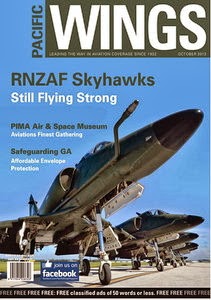
Pacific Wings 10/2013
Boeing delivered the 223rd and last U.S. Air Force C-17 Globemaster III airlifter today, fulfilling the production contract more than 20 years after the first delivery. The aircraft left Boeing's Long Beach facility to fly to its assignment at Joint Base Charleston, S.C., where a ceremony will mark its arrival. The Air Force was the C-17's launch customer. Since the aircraft's first flight Sept. 15, 1991, it has been the world's only strategic airlifter with tactical capabilities that allow it to fly between continents, land on short, austere runways, and airdrop supplies precisely where they are needed. Boeing continues to produce C-17s for other customers around the world, and maintain and sustain the aircraft through the C-17 Globemaster Integrated Sustainmcnt Program. C-17s have been involved in contingency operations of all types, including flying troops and equipment to Operation Enduring Freedom in Afghanistan and to Operation Iraqi Freedom. The airlifter also has been used in humanitarian missions around the world, including the Japanese and Indian Ocean tsunamis of 2011 and 2004, respectively; Hurricane Katrina in 2005; and the Haitian earthquake of 2010.
Model Airplane International 11/2013
Airfix have opted to release the Mk I first and the box contains two sprues of about 70 parts and one clear sprue with another five parts, whilst the decal sheet is made by Cartograph and the instructions are in Airfix's current format. One aspect of these new Airfix kits that is often the cause of much debate is the varying quality and finesse of the surface detail, however in this kit I was more than satisfied because the panel lines and the fabric rendition are fine and restrained. The engraved lines are maybe just a little bit too deep but this does not matter once they are under a coat of primer and paint; but most importantly they are complete and consistent on all parts. The finely raised ribs and longerons make the fabric covered areas realistic plus there are various panels including the wing gun access panels that slightly protrude from the surface, although I think the rims on the fuselage sides are perhaps a little on the heavy side. It's my opinion, however, that Airfix didn't get right the look of the metal panel fasteners, doing them as rather heavy rivets with semi-round heads, which you are better sanding off.
Air International 11/2013
Eurofighters Typhoon is probably best known for its high-performance flight display routines seen by millions of people around world. The aircraft has been in service for over ten years and has participated in many of the world's most demanding training events: Red Flag in the United States, Anatolian Eagle in Turkey, the Tactical Leadership Programme at Albacete in Spain and its equivalent staged by the United Arab Emirates Air Force at AI Dhafra. The training undertaken in those events tends to focus on the air-to-air role and less on air-to-surface missions. Then, in the spring of 2011, RAF Typhoons were deployed to Gioia del Colle AB in southern Italy to enforce a UN-mandated no-fly zone over Libya to support NATO's Operation Unified Protector. Part of the way in to the air campaign, RAF pilots employed the jet in an operational air-to-surface role for the first time. It was a good demonstration of Typhoon's ability to conduct bombing missions in combat. The weapon employed throughout the campaign was the 1,0001b (454kg) Enhanced Paveway II laser-guided bomb, stablemate of the 1,000lb unguided bomb - the only two air-to-surface munitions currently in the RAF's multi-role Typhoon arsenal. After ten years of service and an even greater length of time in development, Typhoon seems somewhat under equipped for 'blowing stuff up', but not for much longer. When the Phase 1 Enhancement (P1E) package is released to service next year RAF Typhoon FGR4s will gain a very smart weapon: the 500lb (227kg) Paveway IV dual-mode, precision-guided bomb.
Subscribe to:
Posts (Atom)